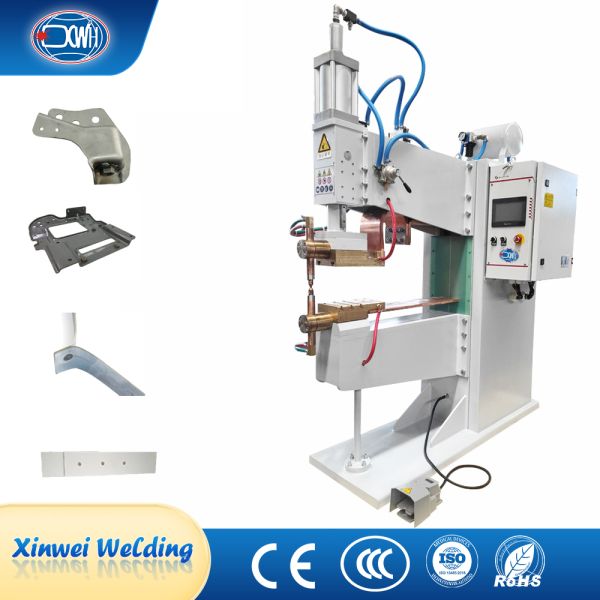
Vibratory Weld Nut Automatic Screw Bowl Feeder Machine
Product Introduction:
The nut conveyor's technical foundation relies on vibratory feeding
and precise guidance systems. Its operational process follows a
meticulously coordinated mechanical sequence: “sorting, orienting,
separating, conveying, and positioning.” Initially, bulk nuts are
organized into orderly arrangements, with posture alignment
accomplished via specialized spiral tracks inside the vibrating
bowl. They are then transported smoothly by a linear vibratory
feeder. Finally, individual nuts are separated from the track and
accurately delivered—using either high-pressure air jets or
mechanical pick-and-place mechanisms—directly above the workpiece’s
threaded hole, where they await the tightening operation by the
actuator.
Features:
1.High-speed delivery capability: Powered by compressed air, nuts
are propelled through precisely engineered conveyance tubes and can
be delivered to the target location within milliseconds. This makes
the system especially suitable for high-speed production lines
where rapid assembly cycles are critical, substantially boosting
overall productivity.
2.Streamlined system design: The system primarily consists of a
vibratory bowl feeder and a high-pressure blowing module, with
minimal mechanical moving parts. This simplified architecture
ensures greater operational reliability, reduced downtime, and
easier maintenance—typically limited to keeping the air supply
clean and the tracks unobstructed.
3.Strong cost efficiency: This approach represents one of the most
economical solutions for automated part handling, both in terms of
initial investment and long-term upkeep. It offers an accessible
automation option for companies with limited capital or those
seeking a quick return on investment, resulting in a short payback
period.
4.Flexible installation and layout: The delivery tubing can be
easily routed according to the spatial constraints of the workshop,
maneuvering around obstacles to place nuts into narrow or
hard-to-reach positions that may be impractical for robotic access.
Technical Parameters:
| AC220V, 50Hz / 60Hz; Max 250 - 400VA |
| Square, round. Hexagon, T, dome, with cover, with rib, collar etc. |
| |
| |
| |
| 9L (10,000 pcs for M6 nut) |
| |
| |
| |
| |
General Structures:

Detailed Images:
Transportation Pipeline: It is usually a flexible hose made of polyurethane or nylon
material, with quick couplings at both ends. As an exclusive track
connecting the host and the workstation. After the separated
individual nuts enter the pipeline, they will be pushed by
compressed air (blowing type) or mechanical mechanism (pushing
type) that opens instantly, flying at high speed inside the
pipeline and reaching the feeding nozzle at the end. Its
flexibility ensures that it can bend freely with the robotic arm or
moving mechanism.
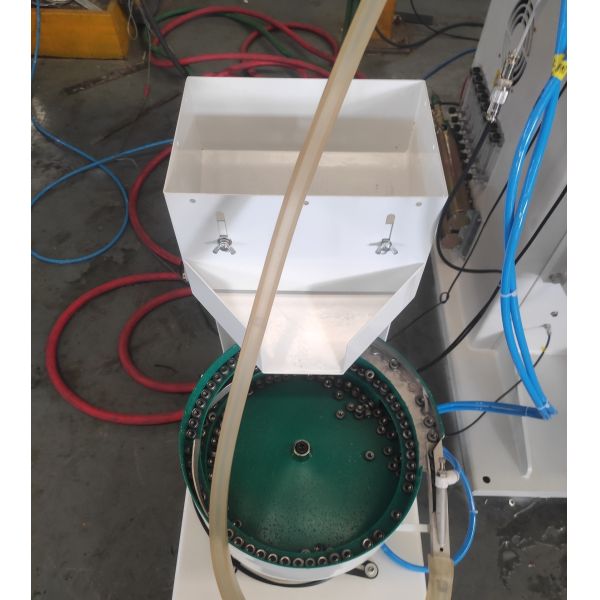
Vibration disk/Hopper: It is a bowl shaped container with a spiral ascending track inside.
By using electromagnetic force or motor drive to generate
high-frequency micro amplitude vibration, the stacked nuts are used
to climb in an orderly manner along a spiral track. During this
process, the nuts will be oriented through specific track
structures (such as notches, stops, blow holes, etc.) to ensure
that all nuts enter the next stage in a uniform posture (such as
threaded holes facing up/down). It is like the "heart" of the
system, providing stable and orderly "blood" (nut) for subsequent
processes.

Direct Vibration Feeder: A linear vibration track, usually separated from but tightly
connected to the vibration disc base. It serves as a 'buffer and
acceleration channel'. Receive the directional nut gushing out from
the outlet of the vibrating disc, and through its own linear
vibration, smoothly and continuously transport the nut to the next
stage - the separation mechanism. It can effectively eliminate
congestion at the outlet of the vibrating disc and provide stable
and uniform nut flow for separation.

Pneumatic System: Including gas source interface, filter, pressure
reducing valve, oil mist device (triple piece), and solenoid valve.
The 'power muscles' that make up the device. Provide clean, dry,
and pressure stable compressed air. This airflow is both the "power
source" that drives the nut to move at high speed inside the
pipeline, and may also be the "driver" that drives the cylinder
type separation mechanism.

Scene Images:

Application:

Supporting Point Projection Welding Machines:
The nut conveyor and fixed spot welding machine are typically
connected in series within automated production lines, forming an
efficient nut welding unit. Their collaborative process is as
follows: First, the nut conveyor uses a vibratory bowl for
orientation and alignment, precisely blowing nuts through pneumatic
tubes onto the positioning pins of the welding gun electrode head.
Next, the spot welding machine drives the upper electrode to
descend, ensuring the workpiece and nut are tightly pressed
together, while the internal clamping device of the conveyor
supports the nut from the rear to prevent displacement. Finally,
the spot welding machine applies a high instantaneous current,
causing the nut's welding protrusion and the workpiece contact
surface to melt instantly, forming a weld nugget and achieving
permanent fixation. The entire process is coordinated via PLC
signals, enabling seamless integration of automatic nut feeding,
precise positioning, and high-strength welding, significantly
improving production cycle time and welding quality consistency.
Double Heads Capacitor Energy Storage Point Projection Welding
Machine
This double headed nut energy storage welding machine achieves
efficient dual station synchronous welding by equipping two
independent nut conveyors. It can simultaneously implant nuts at
two points on the workpiece, which can nearly double the efficiency
compared to single head equipment and greatly optimize the
production cycle. This design is particularly suitable for sheet
metal parts, chassis cabinets, and other products that require
intensive welding of multiple nuts. While ensuring precise
positioning and firm welding, it also ensures the continuity and
high output of the production process.
FAQ:
1. When can you arrange shippment?
The shippment is 15 days after getting deopsit, but customized
machines should be more than 25 days.
2.Do you inspect the finished products?
Yes, each step of production products will be came out inspection
by QC department before shipping.
3.Are you factory?
Yes, we are factory, all machine is made by ourself and we can
provide customize service according to your requirement.
4.How to buy your Spot Welder?
Please send us inquiry to our email, and we will give you a PI to
send us payment.
5. How to contact you?
You can send a mail for us and call us.
6.How will you deliver my goods to me?
We always ship by air and sea in the mean time.
7.How about your transport packing? Is it possible to damage the
machine during the transportation?
We have rich experience on international transportation. All the
packing are extra thickness carton filling with protective PE foam
and waterproof membrane. No damage happened during transportation
until now.
8.What kind of payment do you accept?
T/T, Western Union, PayPal, .L/C, D/A, etc.
Company Profile: